
If your doctor has ordered an MRI and you feel anxious at the thought of lying inside a narrow tube, you are not alone. Research suggests that anywhere from 1 to 15 percent of patients experience claustrophobia severe enough to disrupt or prevent their scan, and many more feel at least some anxiety.
The encouraging news is that you have options. Modern imaging centers in Jersey Cityscan, across Hudson County, offer several types of MRI machines, each with different trade-offs between patient comfort and diagnostic image quality. Understanding these differences can help you make a confident decision and actually get the scan your doctor needs.
This guide explains the three main types of MRI, standard (closed), wide-bore, and open so you and your care team can choose the right one.
A Quick Primer: How MRI Works
Before comparing scanner types, it helps to understand what an MRI machine actually does. MRI uses a powerful magnetic field and radio waves not radiation to produce detailed images of your body’s soft tissues, joints, organs, and nervous system. The strength of the magnetic field, measured in Tesla (T), directly affects how sharp and detailed those images are.
The main structural difference between MRI types is the design of the magnet that generates this field, and that design determines both how enclosed you feel and how strong the imaging signal is.
The Three Types of MRI: Standard, Wide-Bore, and Open
1. Standard (Closed-Bore) MRI
Bore diameter: ~23.5 inches (60 cm) Magnet strength: 1.5T – 3T
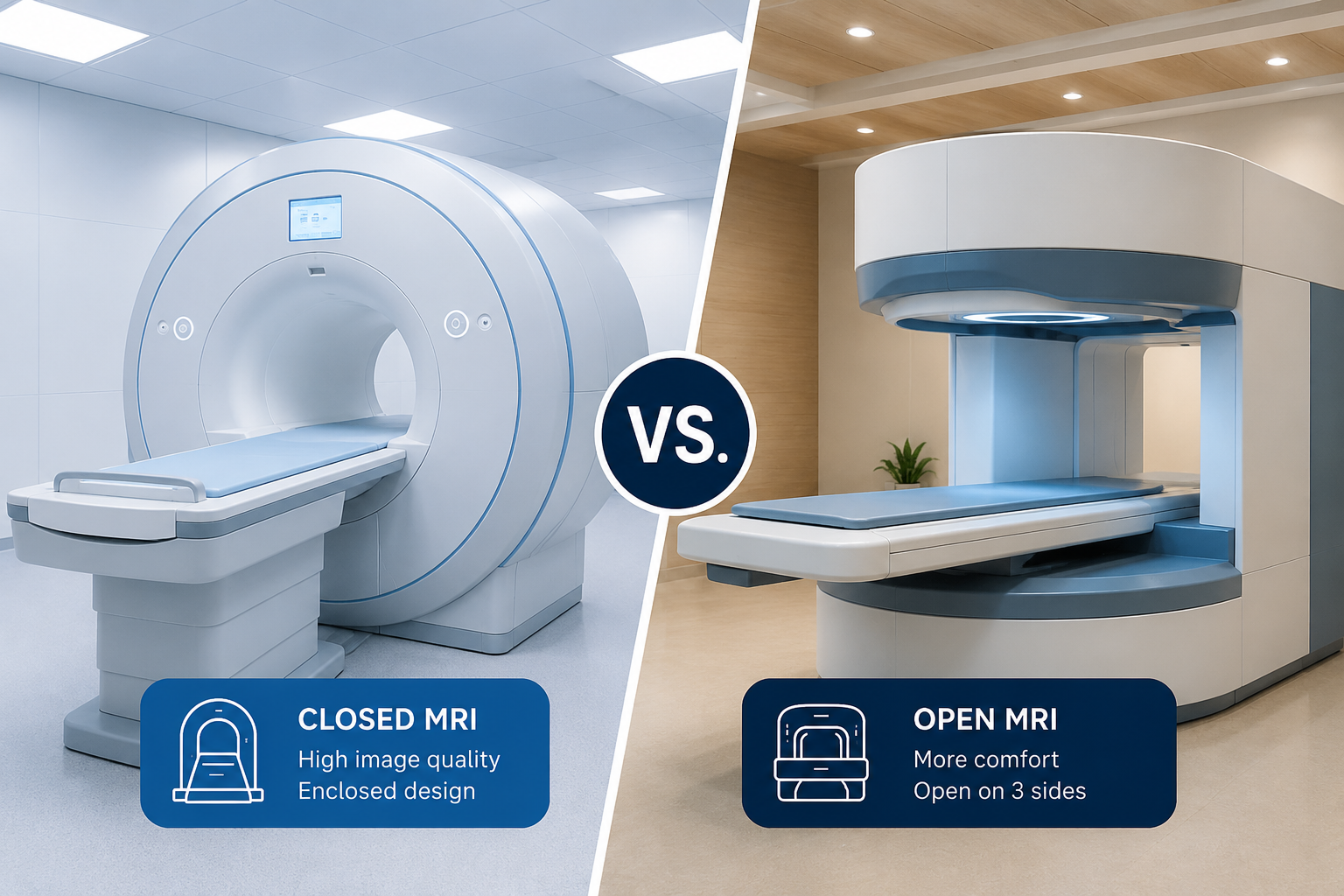
The standard closed MRI is a cylindrical tube that fully surrounds the patient during scanning. It is the workhorse of diagnostic imaging, delivering the highest image quality and fastest scan times of any MRI type.
Because the magnet wraps completely around you, it generates a strong, uniform magnetic field that captures exceptionally fine detail. This makes it the preferred choice when your doctor needs to detect subtle abnormalities: small brain lesions, early-stage multiple sclerosis plaques, fine cartilage damage, or soft tissue tumors.
The drawback: the bore is only about 23.5 inches in diameter, roughly the width of a standard doorway, but at close range, patients enter head-first or feet-first into the tunnel. This confined environment is the source of most MRI anxiety. For patients with significant claustrophobia, larger body types, or difficulty lying still, it can be challenging.
2. Wide-Bore MRI
Bore diameter: ~27.5 inches (70 cm) Magnet strength: 1.5T – 3T
Wide-bore MRI is the most common solution for patients who are anxious about standard MRI. The opening is approximately four inches wider, a meaningful difference when you are lying inside it. The bore is also shorter in length than standard models, meaning less of the machine surrounds you.
Critically, wide-bore MRI maintains the same magnetic field strength as standard closed MRI (1.5T to 3T). This means image quality is equivalent to your doctor getting the same diagnostic detail. You simply have more room, better ventilation, and improved lighting.
Who benefits most: Patients with mild to moderate claustrophobia, larger body types (wide-bore machines accommodate up to approximately 550 lbs), and those who feel anxious but can manage with extra space and support from the technologist.
For the majority of patients who have anxiety about MRIs, wide-bore is the recommended starting point; it resolves the comfort concern without compromising diagnostic accuracy.
3. Open MRI
Design: Open on three sides Magnet strength: 0.3T – 1.2T
Open MRI machines have magnets positioned above and below the patient rather than surrounding them in a tube. The result is a machine that is open on three sides, with no enclosure around the patient’s sides or front.
For patients with severe claustrophobia, this design is transformative. There are no walls closing in, the environment is quieter, and many patients who have previously refused or been unable to complete a standard MRI successfully complete an open scan.
The trade-off: image quality. Because the magnetic field is weaker (typically 0.3T to 1.2T compared to 1.5T to 3T in closed systems), open MRI images are less detailed. Scans also take significantly longer, often twice as long as a standard closed MRI. For many routine diagnostic questions, this image quality is still sufficient. But for complex neurological cases, small joint evaluation, early-stage disease detection, or cancer staging, a closed or wide-bore MRI may be clinically necessary.
Who benefits most: Patients with severe or debilitating claustrophobia who cannot tolerate any enclosed space, children who find the open environment less intimidating, patients with physical disabilities or limited mobility requiring flexible positioning, and patients with huge body sizes.
Side-by-Side Comparison: Standard vs. Wide-Bore vs. Open MRI
| Feature | Standard (Closed) MRI | Wide-Bore MRI | Open MRI |
|---|---|---|---|
| Bore Opening | ~23.5 in (60 cm) | ~27.5 in (70 cm) | Fully open on 3 sides |
| Magnet Strength | 1.5T – 3T | 1.5T – 3T | 0.3T – 1.2T |
| Image Quality | Excellent | Excellent | Good – Lower detail |
| Claustrophobia Relief | Least comfortable | Good for mild to moderate anxiety | Best for severe claustrophobia |
| Scan Speed | Fastest | Fast | Slower (approximately 2× longer) |
| Noise Level | Loud | Loud (some quieter models available) | Quieter |
| Best For | Complex and highly detailed diagnostic imaging | Most patients, including those with mild anxiety or claustrophobia | Patients with severe claustrophobia, larger body types, or children |
| Weight Capacity | Up to approximately 350 lbs | Up to approximately 550 lbs | Varies by MRI model |
Does Image Quality Actually Matter for My Scan?
This is the most important practical question. The honest answer: it depends on what your doctor is looking for.
When standard or wide-bore MRI (1.5T–3T) is clinically important, it is used for:
- Brain and spinal cord conditions: multiple sclerosis, tumors, small lesions, early strokes
- Soft tissue cancer evaluation and staging
- Small joint imaging: wrist, ankle, fingers, where fine cartilage and ligament detail is critical
- Post-surgical evaluation where subtle changes matter
- Complex neurological workups requiring multiple sequence types
When open MRI image quality is generally sufficient:
- Routine musculoskeletal injuries: knee, shoulder, hip, spine imaging for common conditions
- Follow-up imaging where the general structure is the focus, not fine detail
- Situations where the alternative is no scan at all; a lower-quality image is always more useful than an incomplete or abandoned scan
- Pediatric imaging where patient cooperation is easier in an open environment
In short, your doctor ordered a specific MRI for a specific reason. Before choosing a scanner type based purely on comfort, have a conversation with your referring physician about whether the diagnostic question requires high-field imaging or whether an open MRI would provide sufficient information for your case.
Need a Comfortable MRI Experience?
Experience accurate diagnostic imaging with our advanced 1.5T Wide-Bore MRI. Designed for greater comfort and less anxiety, our experienced team is here to make your MRI experience smooth, stress-free, and convenient.
📞 Call (551) 353-9911 Book Your MRITips for Managing MRI Anxiety Regardless of Scanner Type
Even patients who choose a wide-bore or open MRI can benefit from anxiety management strategies. Here is what tends to help most.
Before Your Appointment
- Tell your doctor: If you have significant anxiety or claustrophobia, say so when you receive the referral not the day of the scan. Your doctor can prescribe a mild anti-anxiety medication (sedative) in advance.
- Visit the center: Many Jersey City imaging centers welcome patients for a brief tour of the scan room before their appointment. Seeing the machine in advance demystifies it significantly.
- Ask about scanner options: Call ahead and ask whether a wide-bore machine is available. If standard bore is the only option, ask whether sedation is offered.
- Practice breathing exercises: Slow, controlled abdominal breathing before and during the scan helps regulate the anxiety response. Practicing ahead of time makes it easier to use in the moment.
On Scan Day
- Request music or headphones: Most Jersey City imaging centers offer music through headphones during the scan. Having something to focus on significantly reduces perceived confinement.
- Close your eyes before you enter: Many patients find that not watching the machine approach them makes entry much easier.
- Position your call button: Know that you are in complete control and can pause the scan at any time by pressing the call button. This sense of agency reduces panic.
- Bring a support person: A family member or friend can often remain in the scan room (after metal screening) and hold your hand or leg during the procedure.
- Focus on your breathing: Count breaths rather than counting time. It keeps your mind occupied and your body relaxed.
If sedation is prescribed, arrange for someone to drive you to and from the appointment, and confirm with the imaging center that they are equipped to administer sedation safely.
Which MRI Type Is Right for You? A Quick Decision Guide
| My Situation | Best MRI Option |
|---|---|
| My scan is for a complex neurological or soft-tissue condition. | Closed MRI (1.5T or 3T) – Provides the highest diagnostic accuracy and exceptional image quality for detecting neurological disorders, ligament injuries, muscle tears, tumors, and other complex conditions. |
| I feel mildly anxious in tight spaces but can manage with reassurance and support. | Wide-Bore MRI – Offers extra space and greater comfort while maintaining image quality comparable to a traditional closed MRI scanner. |
| I have moderate to severe claustrophobia. | Wide-Bore MRI is usually the preferred choice. If the wider opening is still uncomfortable, an Open MRI may be recommended for a more relaxed experience. |
| I have severe, debilitating claustrophobia. | Open MRI provides the least confined environment. If the highest image quality is required, your physician may recommend sedation with a closed or wide-bore MRI. |
| I am a larger patient or have mobility limitations. | Wide-Bore MRI (supports patients up to approximately 550 lbs) or an Open MRI can provide greater accessibility and improved patient comfort. |
| I am a child or accompanying a child for an MRI scan. | Wide-Bore MRI or Open MRI helps create a less intimidating environment, making the experience more comfortable for pediatric patients. |
| Speed is a priority due to an urgent referral or acute injury. | Closed MRI or Wide-Bore MRI typically completes scans significantly faster than an Open MRI while maintaining excellent diagnostic quality. |
| My doctor needs the finest image detail for a complex diagnosis. | 3T Closed MRI delivers the highest image resolution, making it the preferred choice for detailed neurological, musculoskeletal, vascular, and complex diagnostic imaging. |
What MRI Options Are Available in Jersey City?
Jersey City Imaging Center at 2300 JFK Boulevard offers a wide-bore 1.5T MRI system designed for patient comfort while delivering full diagnostic image quality. Our bore accommodates a wider range of patients, and our technologists are experienced in working with anxious patients to make each scan as calm and comfortable as possible.
For patients with severe claustrophobia that cannot be managed with a wide-bore scanner and relaxation support, we can discuss sedation options and coordinate with your referring physician. Contact us before your appointment to discuss your specific situation. We will help you find the right approach.
Frequently Asked Questions
For many routine musculoskeletal scans, open MRI provides diagnostically sufficient images. However, for complex neurological conditions, cancer staging, or cases requiring fine soft-tissue detail, closed or wide-bore MRI (1.5T – 3T) delivers significantly higher image quality. Your doctor can advise on which is appropriate for your specific diagnostic question.
Several imaging facilities in Hudson County and the broader NJ metro area offer open MRI options. Jersey City Imaging Center offers wide-bore MRI, which resolves claustrophobia for most patients while maintaining full diagnostic image quality. Contact us or ask your doctor’s office about open MRI referral options in the area.
No, they are different. A wide-bore MRI is still a closed tunnel, but the opening is approximately four inches wider than a standard bore (27.5 inches vs. 23.5 inches). It maintains the high magnetic field strength (1.5T – 3T) of a standard closed MRI. An open MRI has magnets above and below the patient with no surrounding walls but operates at lower magnetic field strength (0.3T – 1.2T). A wide bore is the most common and recommended first choice for claustrophobic patients because it combines comfort with full diagnostic quality
Standard closed MRI accommodates most patients up to approximately 350 lbs with a 23.5-inch opening. Wide-bore MRI extends the limit to approximately 550 lbs with a 27.5-inch opening. Open MRI varies by model. If you have concerns about fit, contact the imaging center in advance with your approximate height and weight. Staff can advise whether your body type is accommodated and which machine is most appropriate.
Yes. If you have significant anxiety or claustrophobia, speak with your referring physician before your MRI appointment. They can prescribe a mild sedative for you to take before the scan. Imaging centers can administer IV sedation in some cases. Note that if you receive sedation, you will need a driver to take you home, and you should not drive or operate machinery for the remainder of the day.

