
Quick answer
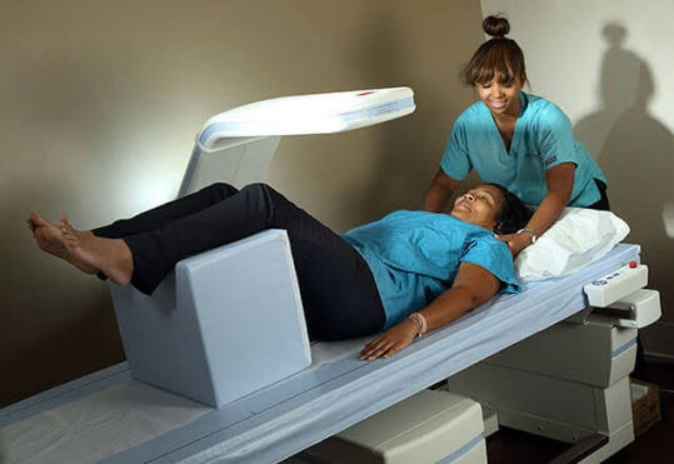
A bone density test, also called a DXA or DEXA scan, is a painless, low-dose X-ray exam that measures the mineral content of your hip and spine. It takes about 10 to 15 minutes, requires no needles or dye, and produces a T-score that tells your doctor whether your bones are normal, thinning (osteopenia), or osteoporotic. Most adults getting a bone density test in Jersey City are in and out of the imaging center in under half an hour.
What a bone density test actually measures
Bone is living tissue. It rebuilds itself constantly, and somewhere around age 30 the rebuilding starts losing ground to the breakdown. That loss is invisible. You cannot feel your skeleton getting lighter, and a standard X-ray will not flag it until roughly a third of your bone mass is already gone.
A DXA scan closes that gap. It measures bone mineral density (BMD), grams of calcium and other minerals packed into each square centimeter of bone, at the two sites that matter most clinically: the lumbar spine (L1–L4) and the proximal femur, meaning the hip. Those sites are chosen because they are where fractures cause the most harm and because they respond first to hormonal change, steroid use, and aging.
The number itself is not the point. The point is comparison: how your density stacks up against a healthy young adult reference population and how today’s scan compares to the one you had two years ago.
How a DXA scan works
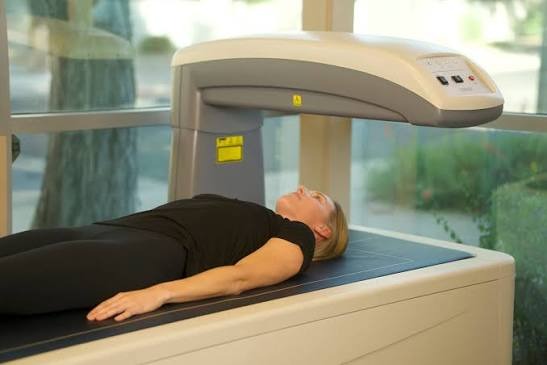
DXA stands for dual-energy X-ray absorptiometry. The “dual-energy” part is what makes it clever.
The scanner sends two X-ray beams of different energy levels through the same patch of your body. Soft tissue, muscle, fat, and skin absorb those two energies in one predictable ratio. Bone mineral absorbs them in a different ratio. A detector arm above you records what comes through, and software subtracts the soft-tissue signal, leaving a clean measurement of bone alone.
That subtraction is why DXA is the reference standard. Ordinary radiographs cannot separate bone from everything stacked in front of and behind it. DXA can, which is why the World Health Organization built its osteoporosis definitions around DXA numbers rather than any other imaging test.
The radiation question
This is the first thing most patients ask. A DXA scan delivers roughly 1 to 10 microsieverts per site. A chest X-ray is around 100 microsieverts. A cross-country flight exposes you to about 40. In practical terms, your scan costs you the equivalent of a day or two of simply standing outside on Earth. The pregnancy screening question at check-in is standard caution, not a signal of meaningful risk.
Who should get a bone density test?
Screening guidelines from the U.S. Preventive Services Task Force, the Bone Health & Osteoporosis Foundation, and most endocrinology societies converge on a similar list. Consider a scan if you are:
- A woman 65 or older, or a man 70 or older; screening is recommended regardless of other risk factors.
- Postmenopausal and under 65 with added risk: low body weight, a parent who fractured a hip, current smoking, or three or more alcoholic drinks a day.
- Anyone over 50 who has broken a bone from a fall at standing height or less. That is a fragility fracture, and it changes your risk profile immediately.
- Long-term glucocorticoids (prednisone for three months or more), aromatase inhibitors, androgen-deprivation therapy, or certain anti-seizure medications.
- Living with rheumatoid arthritis, celiac or inflammatory bowel disease, chronic kidney disease, hyperparathyroidism, hyperthyroidism, type 1 diabetes, or a history of bariatric surgery.
- Losing height—more than 1.5 inches from your peak adult height often signals undetected vertebral compression fractures.
If two or more of those describe you, a DXA scan in New Jersey is worth raising at your next primary care visit rather than waiting for a milestone birthday.
What to expect, step by step
Before you go
Preparation is genuinely minimal. Eat normally. Take your usual medications. The two rules that matter:
- Stop calcium supplements for 24 hours before the exam; undissolved tablets in the gut can sit over the spine and distort the reading.
- Wait 10 to 14 days after any barium study, CT with contrast, or nuclear medicine scan. Residual contrast will invalidate the measurement.
Wear something soft with no metal: sweatpants, a cotton tee, no zippers, no belt buckle, and no underwire. If your outfit has hardware, you will be handed a gown, which adds five minutes you did not need to spend.
During the scan
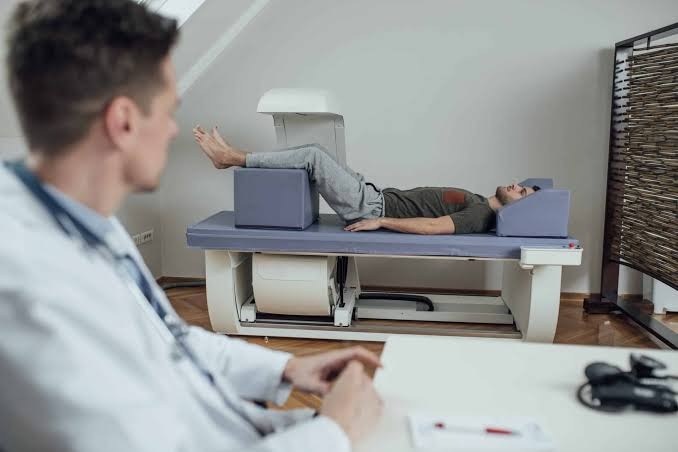
You lie on your back on a padded, open table. Nothing encloses you; there is no tunnel, no tube, and no reason for claustrophobia. A flat C-arm passes slowly a foot or so above your body.
For the spine scan, the technologist slides a padded cube under your knees. Raising your legs flattens the lumbar curve against the table so the vertebrae separate cleanly on the image. For the hip scan, your foot goes into a soft brace that rotates the leg inward about 15 to 25 degrees, which swings the femoral neck into full profile. Both positions feel mildly awkward and are completely painless.
Then you hold still and breathe normally. Each site takes one to two minutes. Some centers add a forearm scan if the hip or spine is unreadable, common after spinal fusion or hip replacement, since hardware blocks the beam.
After
You get up and leave. No recovery, no sedation, no restrictions, no one who needs to drive you home. A board-certified radiologist interprets the study and sends the report to your referring physician, typically within 24 to 72 hours.
Worth knowing: many facilities now add a vertebral fracture assessment (VFA), a quick lateral image of the spine, to the same appointment. It catches silent compression fractures that never caused symptoms, and it adds about two minutes.
Reading your results: T-scores and Z-scores
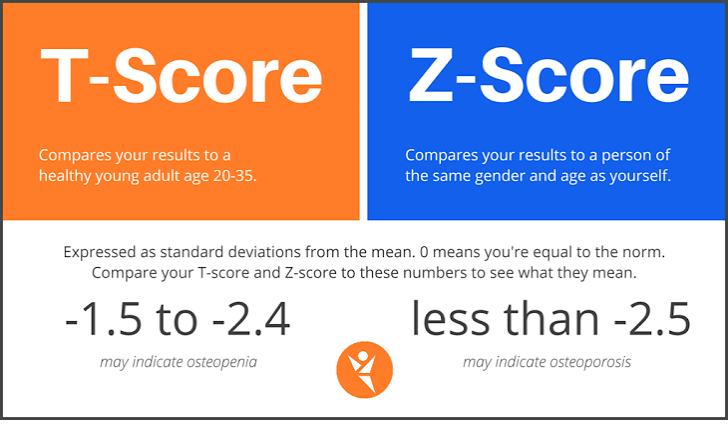
Your report leads with a T-score: how many standard deviations your bone density sits above or below the average healthy 30-year-old of your age.
| T-score | Classification | What it generally means |
| −1.0 and above | Normal | Density within the expected healthy range |
| −1.1 to −2.4 | Osteopenia (low bone mass) | Below normal, not yet osteoporosis; risk assessment guides next steps |
| −2.5 and below | Osteoporosis | Fracture risk is materially elevated; treatment is usually discussed. |
A second number, the Z-score, compares you to people of your own age and body size. It is the most meaningful figure for premenopausal women, men under 50, and children. A Z-score at or below −2.0 suggests something beyond normal aging is driving bone loss and usually prompts bloodwork for secondary causes.
Most reports also include a FRAX score: your estimated 10-year probability of a major osteoporotic fracture, calculated from your hip density plus clinical risk factors. FRAX is often what tips the decision on whether someone with osteopenia starts medication, so ask about it if your T-score lands in that middle band.
One caution worth carrying into your follow-up appointment: advanced spinal arthritis, scoliosis, and aortic calcification can all inflate a lumbar reading. If your spine and hip scores disagree sharply, the hip is usually the more reliable number.
Cost, Insurance, and how often to repeat
Medicare Part B covers a screening bone density test every 24 months for qualifying beneficiaries, and more often when medically justified, for example, during the first year of steroid therapy or after starting osteoporosis treatment. Most commercial insurers in New Jersey follow comparable rules. Self-pay pricing at a local imaging center typically runs $75 to $250, depending on whether VFA and body composition are bundled in.
The standard follow-up interval is two years, tightened to one year for patients on active treatment or high-dose corticosteroids. Normal results with no risk factors may justify a longer gap.
One practical detail matters more than people expect: go back to the same machine. Densitometers from different manufacturers are calibrated differently, and a change of scanner can produce a difference that looks like real bone loss but is not. Consistency is what makes serial scans interpretable.
Choosing a Jersey City imaging center
If you are searching for a DXA scan near Jersey City, NJ, the machines themselves are largely interchangeable; the difference lies in the workflow around a Jersey City imaging center. Before booking, ask:
- Is the facility ACR-accredited for bone densitometry, and is the interpreting radiologist certified in densitometry (CCD)?
- Will I be scanned on the same unit at follow-up? Multi-site groups sometimes rotate patients between locations, which breaks comparability.
- Is FRAX included in the report, and is VFA available in the same visit?
- Do you need a prescription? Most centers offering Jersey City DXA scans require a physician order, primarily for insurance. Some accept self-pay walk-ins.
- How are results delivered? A patient portal that hands you the actual T-score, not just a “results are normal” phone call, is worth a lot at your next visit.
Jersey City patients also have a scheduling advantage: with facilities clustered near Journal Square, Newport, and Grove Street, a PATH-accessible appointment is easy to slot into a weekday morning. If you are searching “DXA scan near me” from Hoboken, Bayonne, or Union City, the same centers are usually within a 15-minute ride.
Book your bone density test in Jersey City.
Fifteen minutes now is a reasonable trade for knowing your fracture risk a decade early, especially if you are postmenopausal, over 70, on long-term steroids, or have broken a bone since 50. Talk to your physician about a referral, or call a local imaging center to ask about self-pay screening.
Frequently asked questions
How long does a DXA scan take?
About 10 to 15 minutes door to door, with roughly one to two minutes of actual scanning per site. You stay dressed if your clothing has no metal.
Is a bone density test painful?
No. There are no needles, no injections, no contrast, and no enclosed space. The only mild discomfort is holding a position for a minute or two.
Can I eat before my appointment?
Yes. No fasting is required. Skip calcium supplements for 24 hours beforehand, since undissolved tablets can interfere with the spine measurement.
Do I need a referral for a DXA scan in New Jersey?
Usually yes, most imaging centers require a physician order, largely because insurers need one on file. A few offer self-pay screening without a referral, so ask when you call.
What if I have a hip replacement or spinal hardware?
Metal blocks the beam, so that site cannot be measured. The technologist will scan the opposite hip, and if both are unusable, the non-dominant forearm is the standard substitute.
Can a DXA scan tell me if I already have a fracture?
A standard scan measures density, not fractures. Vertebral fracture assessment, an optional add-on image, is designed to detect silent spinal compression fractures during the same appointment.
Medical Disclaimer
The information provided in this article is for educational and informational purposes only. It is not intended to replace professional medical advice, diagnosis, or treatment. Always consult your physician or another qualified healthcare provider regarding your health concerns. If you are experiencing a medical emergency, call 911 or visit your nearest emergency department immediately.
Need Diagnostic Imaging?
Schedule your MRI, CT Scan, X-Ray, Ultrasound, or other diagnostic imaging services with Jersey City Imaging Center. Our experienced team provides advanced technology, fast appointments, and compassionate care.

